Permanent Outdoor Lighting for Fences
Permanent outdoor lights are suitable for fence lighting because a fence provides a continuous architectural line that can support low-profile lighting across property borders, backyard spaces, gates, privacy fences, and pool areas. Permanent fence lighting can provide subtle everyday illumination, define the perimeter after dark, and switch to colors or scenes for holidays and events without installing temporary lights. With BlueHopper, fence lighting can operate as its own controllable zone or coordinate with roofline, landscape, patio, and other permanent outdoor-lighting areas.
What Types of Fences Work With Permanent Outdoor Lighting?
Permanent outdoor lighting can work with many fence styles when there is a suitable structural surface for securely mounting the lighting track and routing the associated cabling.
Privacy fences, garden fences, decorative fencing, pool fencing, perimeter walls, gates, rails, and other boundary structures can all provide useful lighting locations depending on their construction.
The mounting approach should follow the fence rather than forcing every fence into the same configuration. A broad privacy-fence rail provides a different installation surface from a narrow metal frame or decorative gate.
The strongest application is one where the permanent lighting appears integrated with the structure instead of looking like seasonal lights attached afterward.
Where Should Permanent Lights Be Positioned on a Fence?
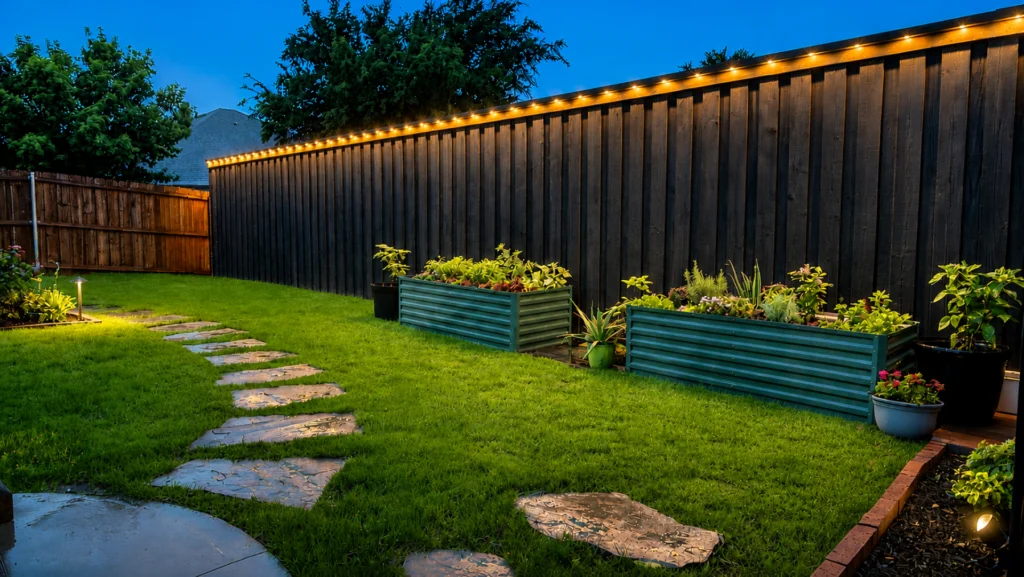
Permanent fence lights should be positioned along structural lines that provide a continuous visual path while keeping the fixtures and wiring discreet during daylight.
The top rail is often a natural location because it follows the overall shape of the fence and can create a consistent illuminated border after dark. Other fences may provide better mounting positions along horizontal rails, framing members, gate structures, or architectural borders.
Placement should also reflect the desired effect. Lighting directed toward the yard can provide a different experience from lighting positioned primarily to make the fence line visible from a distance.
A permanent installation should therefore consider the fence structure, normal viewing direction, and the space the lighting is intended to illuminate.
How Does Permanent Fence Lighting Define a Property Border?
Permanent fence lighting can define a property border by turning an otherwise dark perimeter into a visible architectural line after sunset.
This is particularly useful in backyards where the house, patio, or landscape may be illuminated while the outer edge of the property disappears into darkness.
A softly illuminated fence can create visual depth by establishing a background boundary behind patios, pools, lawns, and landscape areas.
The fence does not need to become the brightest element in the scene. Its role can remain secondary while still making the dimensions of the outdoor space easier to understand at night.
Can Permanent Fence Lighting Be Used on Privacy Fences?
Permanent outdoor lighting works well on privacy fences because their continuous rails and broad structural surfaces can support a clean, consistent lighting run.
A privacy fence can be treated as a background architectural element rather than simply as a property barrier. Subtle lighting along the fence line can add depth behind a patio, lawn, garden, or outdoor-living area without requiring temporary string lights.
The lighting should remain proportional to the space. A long fence run generally benefits from consistent positioning and restrained brightness so it defines the perimeter without dominating the backyard.
Permanent track also helps keep the installation organized during daylight when the lighting is not in use.
How Can Permanent Lighting Be Used Around Fence Gates?
Permanent lighting around gates can help maintain visual continuity where a fence line is interrupted by an entrance or access point.
The gate itself may be treated as part of the main lighting run or given slightly greater emphasis when it serves as an important entry into the yard, driveway, or pool area.
The key is maintaining alignment across the transition. If the permanent lighting stops abruptly before the gate and restarts afterward without a visual relationship, the perimeter can feel disconnected.
A properly planned gate section allows the illuminated boundary to remain understandable while still respecting hinges, openings, hardware, and other moving components.
Can Permanent Outdoor Lights Be Used on Pool Fencing?
Permanent outdoor lighting can be incorporated around suitable pool fencing and perimeter structures when the lighting and installation are designed for the surrounding outdoor environment.
Fence lighting around a pool can help visually define the enclosure and connect it with nearby patio, landscape, or pool-cage lighting.
The fence should remain a supporting lighting layer rather than introducing excessive brightness directly around the water.
Where pool fencing forms part of a larger backyard system, its lighting can operate independently for ordinary evenings and coordinate with other outdoor zones when a unified scene is wanted.
How Bright Should Permanent Fence Lighting Be?
Permanent fence lighting usually works best at a lower visual intensity than primary roofline or architectural lighting because its role is often to define the perimeter rather than become the main focal point.
A fence behind a patio or landscaped yard can provide a soft background layer while brighter architectural or feature lighting remains closer to the house.
Brightness can then be adjusted according to use. Everyday fence lighting may remain subtle, while holidays, parties, or events can use stronger colors or more expressive scenes.
BlueHopper allows brightness and scenes to be adjusted digitally, so the permanent fixture layout does not need to change when the desired atmosphere changes.
Can Permanent Fence Lighting Use Everyday White and Color?
Permanent fence lighting can provide restrained everyday illumination and switch to color for holidays, parties, sporting events, or other programmed scenes without changing the installed lights.
For normal evenings, a fence may use a subtle white setting that provides visual definition without making the yard look decorative.
When the property changes for an occasion, the same fence can become part of a coordinated color scene with the roofline, landscape, patio, or pool area.
BlueHopper supports 16 million+ colors, scenes, brightness adjustment, and scheduling, giving permanent fence lighting both everyday and decorative roles from the same installation.
Can Fence Lighting Operate as a Separate Zone?
Permanent fence lighting can operate as a separate zone so the property perimeter does not have to use the same settings as the roofline, landscape, or outdoor-living areas.
For example, a homeowner may keep low-level fence illumination active in the backyard while the front roofline remains off. During a holiday or event, the fence can then join other zones in a coordinated scene.
This separation is useful on larger properties where the fence serves a different purpose from the lighting closer to the house.
BlueHopper zones can be controlled independently or grouped together, allowing the perimeter to remain part of the same permanent outdoor-lighting system without behaving like one single lighting circuit.
Can Permanent Fence Lighting Be Scheduled?
Permanent fence lighting can run on schedules so the perimeter follows a normal evening routine without requiring manual control every day.
A backyard fence might turn on after sunset and remain active during the hours when the patio or yard is normally used. It can then switch off independently from pathway or entrance lighting later in the evening.
Scheduled operation is particularly useful when the fence is primarily an ambient background layer rather than something the homeowner wants to manage manually.
BlueHopper scheduling allows different lighting areas to follow their own routines while remaining available for temporary scene changes whenever needed.
How Should Permanent Fence Lighting Work With a Patio or Backyard?
Permanent fence lighting should create a background layer that gives patios, seating areas, lawns, and other backyard spaces a stronger sense of enclosure after dark.
The fence establishes the outer boundary while patio and landscape lighting illuminate the spaces where people actually spend time.
This creates depth from the house outward:
patio or outdoor living area → landscape → illuminated fence boundary
The layers do not need identical brightness or colors. Subtle fence lighting can remain behind a warmer patio scene, while the two zones can synchronize when the homeowner wants a coordinated event or holiday display.
Can Fence Lighting Coordinate With Permanent Roofline Lighting?
Permanent fence lighting can coordinate with roofline lighting while serving a different physical part of the property.
Roofline lighting defines the architecture of the house. Fence lighting extends the permanent-lighting system outward to the property boundary.
For everyday use, the two may operate independently. The roofline might use warm-white architectural lighting while the fence remains at a lower brightness in the backyard.
For Christmas, game day, or another event, both zones can use coordinated colors and scenes to visually connect the house with the surrounding property.
This allows permanent outdoor lighting to extend beyond the structure itself without requiring separate temporary lighting around the perimeter.
Should an Entire Fence Be Illuminated?
An entire fence does not always need permanent lighting. The strongest coverage depends on which fence sections are visible and how they relate to the parts of the property people actually use.
A backyard fence behind a patio or pool may benefit from a continuous run because it forms an important visual boundary. A side fence hidden behind landscaping or rarely visible from occupied areas may need less emphasis.
Selective coverage can also prevent the perimeter from overpowering the architecture.
The decision should be based on visibility, outdoor use, and the role the fence plays in the overall property rather than simply illuminating every available section.
What Makes Permanent Outdoor Lighting Work Well on a Fence?
Permanent outdoor lighting works well on a fence when the lighting follows the structure cleanly, remains visually integrated during daylight, and gives the perimeter a clear purpose after dark.
The mounting line should remain consistent across fence runs and gates, brightness should support rather than overpower the surrounding yard, and sections that need independent operation should be planned as separate zones.
With BlueHopper, fence lighting can remain a subtle everyday background, operate on its own schedule, or coordinate with roofline, landscape, patio, and other lighting areas for a property-wide scene.
The result is a permanent fence-lighting system that turns the property border into a controlled architectural layer instead of relying on temporary lights whenever the backyard needs illumination.