Permanent Lighting for Pool Cages
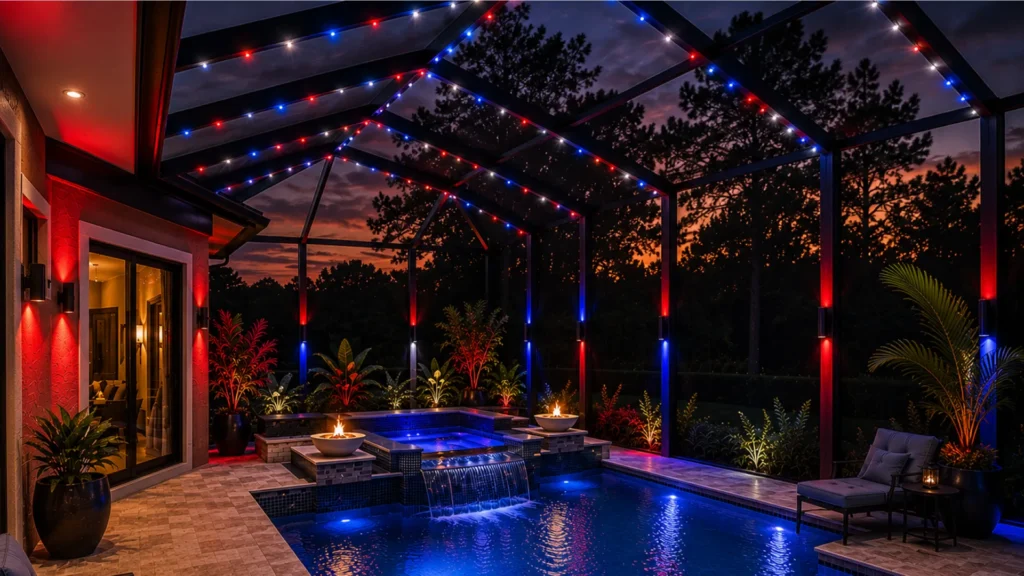
Permanent lighting around a pool cage works by integrating low-profile fixtures along the enclosure’s structural frame so the lighting follows the architecture instead of hanging across the screen as temporary strings. Perimeter beams can define the shape of the enclosure, while selected horizontal and overhead members can direct light toward the pool deck, seating areas, entrances, and other frequently used spaces. BlueHopper pool-cage lighting can remain in everyday white illumination, operate in separate zones, follow schedules, and switch to RGBW colors and scenes for entertaining or special occasions without changing the installed system.
Where Should Permanent Lights Be Installed on a Pool Cage?
Permanent lights should be mounted along the structural members that contribute most to the enclosure’s shape or provide useful illumination to the pool area below.
Upper perimeter beams can define the overall cage, while lower horizontal members may provide a more direct relationship with seating, walking areas, and the pool deck. Selected overhead runs can add illumination within larger enclosures where perimeter lighting alone would leave the center too dark.
The screen panels themselves are not the lighting structure. The enclosure frame provides the stable architectural path that allows the lighting to remain aligned and visually integrated.
A strong layout therefore follows the cage geometry instead of simply running lights around every available section.
Should Pool-Cage Lights Face Inward or Outward?
Inward-facing permanent lighting is generally more useful when the objective is to illuminate the pool deck, seating areas, and interior of the enclosure. Outward-facing placement places greater emphasis on the structural outline of the cage itself.
The two orientations can be combined where necessary.
A highly visible upper perimeter may benefit from architectural definition, while lower or overhead runs direct usable light into the enclosure.
The viewing position also matters. A pool cage frequently viewed from inside the home may need to look balanced from that direction, while a backyard designed around the pool may place greater emphasis on the experience from inside the enclosure.
Which Parts of a Pool Cage Need the Most Lighting?
The most important areas are usually the sections that affect how people move through and use the enclosure: entry doors, steps, seating areas, walking routes, and the portions of the deck used most frequently after dark.
Large structural spans may need enough lighting to prevent the enclosure from disappearing visually, but every frame member does not need to become an illuminated line.
The pool itself already reflects surrounding light, so a cage can become visually busy when every beam is equally emphasized.
Selective coverage lets the major structural lines remain clear while keeping attention on the usable outdoor space.
How Should Lighting Follow the Pool-Cage Frame?
Permanent pool-cage lighting should maintain a clean relationship with the enclosure’s frame as it moves through horizontal runs, corners, vertical changes, and roof sections.
Long connected runs benefit from consistent alignment. Where the structure changes direction, the lighting path should turn with the architecture rather than cut visually across the screen panels.
Low-profile track helps keep the permanent system close to the frame, making the installation look more like part of the enclosure during daylight.
On a complex cage with several roof angles or structural sections, continuity matters more than forcing every run to use exactly the same orientation.
Can Permanent Lighting Work on Large Screen Enclosures?
Permanent lighting can scale across large screen enclosures by treating the cage as several related lighting areas rather than one enormous illuminated perimeter.
A large enclosure may include separate sections for the pool, dining, lounge seating, entrances, or an outdoor kitchen. Those areas do not necessarily need identical brightness or operating schedules.
Breaking the installation into logical zones gives the structure more flexibility and prevents one setting from having to serve every activity.
This is particularly useful when only part of the pool enclosure is being used on an ordinary evening.
How Should Pool-Cage Lighting Handle Entry Doors?
Entry doors should remain easy to identify without disrupting the visual continuity of the surrounding frame.
Lighting can continue across or around the entrance structure while giving the door area slightly greater visual definition where necessary.
The installation also needs to respect hinges, moving sections, latches, and clearances so permanent track or cabling does not interfere with normal operation.
A well-integrated entrance should look like part of the enclosure lighting rather than a break in the system.
How Should Permanent Lighting Work Around the Pool Deck?
Pool-cage lighting should support the deck without becoming the only source of illumination around it.
The enclosure frame provides an elevated lighting layer, while other fixtures can address steps, pathways, planting, walls, or seating areas closer to ground level.
This combination avoids concentrating all of the light overhead.
A pool deck used for swimming and movement may need more usable illumination than a lounge area at the far end of the enclosure. Separate zones or brightness levels allow those differences to remain visible without redesigning the installation.
How Can Glare Be Reduced Around a Pool?
Glare should be controlled carefully around a pool because water and screen surfaces can reflect bright points of light back toward people using the space.
Fixtures positioned directly in common sightlines can become distracting, particularly when viewed from lounge seating or from inside the house through large windows.
Recessed placement, lower brightness, careful fixture orientation, and indirect architectural illumination can make the enclosure more comfortable.
The objective is not maximum brightness. Light should reveal the structure and usable spaces while avoiding harsh reflections across the water.
Can Pool-Cage Lighting Use Warm White for Everyday Use?
Permanent pool-cage lighting can use restrained white illumination for ordinary evenings and switch to color when the space is used for entertaining, holidays, or events.
Everyday white is often better suited to swimming, dining, and general outdoor use because it preserves a more natural appearance around people, furniture, water, and architectural finishes.
BlueHopper’s RGBW control allows the same installed system to change from white lighting to 16 million+ colors, effects, and scenes without adding temporary decorative lights to the enclosure.
The cage can therefore remain visually calm most nights while still having much greater flexibility when the setting changes.
Should a Pool Cage Have More Than One Lighting Zone?
A larger pool cage benefits from multiple lighting zones when different sections of the enclosure serve different purposes.
The pool perimeter, lounge area, dining section, outdoor kitchen, entrance, and upper architectural frame can operate at different brightness levels or on different schedules.
For example, the deck and entrance can remain illuminated while decorative upper-frame lighting is turned off later in the evening.
BlueHopper zones can also be grouped when the entire enclosure needs one coordinated scene.
Zoning becomes more useful as the cage grows in size and complexity because it prevents the entire structure from behaving like one large lighting circuit.
How Should Pool-Cage Lighting Coordinate With Patio Lighting?
Pool-cage lighting and patio lighting should connect visually without duplicating the same layer of light.
The cage provides architectural definition above and around the pool. A patio can provide a warmer, lower-level environment for dining or conversation beside it.
Keeping those areas independently controllable makes it possible for the pool cage to remain functional while the patio uses a softer scene.
When entertaining, both areas can use coordinated colors or brightness levels so the backyard feels connected rather than divided into unrelated lighting systems.
How Should Landscape Lighting Work Around a Pool Cage?
Landscape lighting outside the screen enclosure can extend the nighttime view beyond the cage instead of allowing the screen to become the visual endpoint of the property.
Trees, palms, garden beds, walls, and other exterior features visible through the screen can provide depth behind the enclosure.
That can be particularly effective when the lighting inside the pool cage remains relatively restrained.
The pool cage then forms the foreground architectural layer, while illuminated landscape features create visual depth farther into the backyard.
Can Pool-Cage Lighting Run Automatically?
Permanent pool-cage lighting can follow schedules so the enclosure does not need to be manually configured every evening.
Everyday white lighting might activate during normal evening hours, reduce later at night, and remain separate from more decorative zones.
Special scenes can temporarily replace that routine for parties, holidays, or other occasions.
Scheduled control is useful around pools because the enclosure may be used regularly even when no decorative lighting is needed.
How Should Pool-Cage Lighting Look During the Day?
Permanent pool-cage lighting should follow the existing structural lines closely enough that the track remains secondary to the frame when the lights are off.
Screen enclosures are visually open structures, so hardware that cuts across panels or ignores the frame geometry can become especially noticeable.
Keeping the fixtures and cabling organized along the enclosure members gives the system a cleaner architectural appearance.
Daytime integration matters here more than on many landscape applications because the pool cage is often viewed at close range from patios, windows, and seating areas.
Does Every Pool-Cage Beam Need Permanent Lighting?
Every beam does not need lighting.
Major perimeter lines, prominent roof sections, entrances, and structural members serving active areas generally provide more value than illuminating every vertical and horizontal frame member.
Too many illuminated lines can turn the cage into a bright geometric grid and compete with the pool and outdoor-living space below.
Selective placement keeps the architecture readable while leaving enough visual quiet for water, furniture, landscape, and other backyard features.
What Makes Permanent Pool-Cage Lighting Work Well?
Permanent pool-cage lighting works best when the enclosure frame determines the lighting path and the way people use the pool area determines which sections receive the most illumination.
Upper structural runs can define the architecture, while targeted lighting supports entrances, deck areas, seating, and other occupied spaces. Independent zones prevent the entire enclosure from operating at one brightness level, and RGBW control lets everyday white lighting shift into more expressive scenes when needed.
A pool cage should feel like part of the backyard architecture after dark—not like a screen enclosure covered with temporary lights.