Permanent Outdoor Lighting for Pergolas
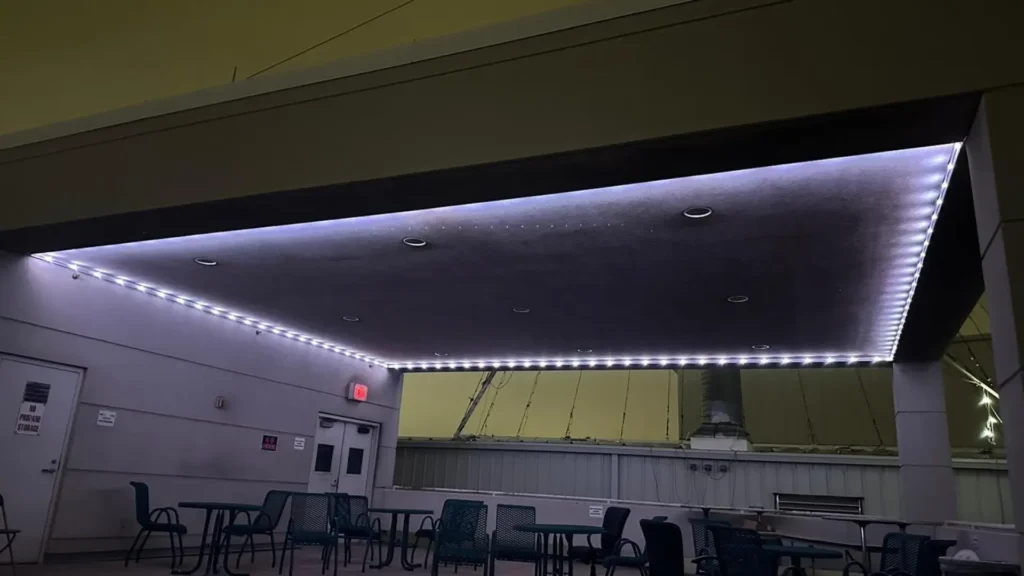
Permanent outdoor lighting can be integrated into a pergola by mounting low-profile lighting along the beams, rafters, perimeter edges, or other structural lines that naturally define the space. Perimeter placement emphasizes the pergola’s architecture, while downward-facing lighting along interior beams provides more useful illumination over seating, dining, and outdoor-living areas. BlueHopper Track-Lite can follow straight, curved, and irregular surfaces while housing both the lights and extension cables, allowing the pergola to remain visually clean during the day and operate as a controllable RGBW lighting zone after dark.
Where Should Permanent Lights Be Installed on a Pergola?
The strongest permanent-lighting locations on a pergola are usually the structural members that either define its shape or sit directly above the areas people use.
Outer beams can outline the perimeter and make the pergola visible from across the yard. Interior beams can place light closer to tables, seating, walkways, or an outdoor kitchen. On a larger structure, both can be used without covering every rafter.
A pergola used mainly as an architectural feature may need only a clean perimeter line. A pergola built around dining and entertaining generally benefits from additional illumination inside the structure.
Should Pergola Lighting Face Outward or Downward?
Outward-facing and downward-facing pergola lighting serve different purposes.
Outward-facing fixtures emphasize the structure itself. They make the outer beams and architectural edges more visible from the yard and can visually connect the pergola with roofline or fence lighting elsewhere on the property.
Downward-facing fixtures concentrate more light inside the pergola, making them better suited to tables, seating areas, countertops, or circulation beneath the structure.
The orientation does not have to remain identical throughout the pergola. An outer beam can define the architecture while an interior run handles the occupied space below.
Which Pergola Beams Actually Need Lighting?
Not every pergola beam needs a permanent lighting run. The main perimeter beams, structural members above frequently used areas, and visually important cross-members normally deserve priority.
Lighting every rafter can create a dense grid of illuminated lines that competes with the open character of the pergola. Selective placement preserves more contrast and keeps attention on the structure rather than the number of fixtures.
A useful distinction is between beams that define the pergola and beams that support the roof structure. The first group is usually more valuable for architectural lighting; the second should be illuminated only when it improves usable light below.
How Is Permanent Lighting Integrated Into Pergola Beams?
BlueHopper Track-Lite mounts closely to the structural surface and contains both the light fixtures and extension cabling within the track. This keeps the lighting path organized along the pergola instead of leaving separate strings and wires visible across the beams.
Track-Lite uses UV-rated acrylic with a fire-retardant base and is available in brown, gray, white, and beige. Those finishes provide options for coordinating the permanent installation with painted, stained, or finished pergola surfaces.
The track can also follow straight, curved, and irregular forms, which matters on pergolas that use arches, angled members, or non-standard beam layouts.
How Does Permanent Lighting Work on an Open-Rafter Pergola?
An open-rafter pergola gives the lighting several possible mounting planes because there is no solid ceiling hiding the structure.
Fixtures can run beneath a beam to illuminate the space below, along a side edge to make the structural line more visible, or around the perimeter to emphasize the overall shape without filling every interior rafter with lights.
Cable concealment becomes especially important on an open structure because the installation can be viewed from several angles. Keeping the lighting and extension cables together inside architectural track helps preserve the open appearance of the pergola.
Open rafters therefore offer more placement flexibility, but they also make clean alignment more visible.
What Changes With a Covered Pergola?
A covered pergola behaves more like a porch or deep soffit because the roof creates a defined overhead surface.
Lighting beneath that cover can concentrate on the occupied area rather than primarily outlining the structure from outside. Downward illumination becomes more valuable over dining tables, seating, counters, and walking areas.
The perimeter can still carry a separate architectural line if the pergola needs to remain visible from the yard.
This gives covered pergolas two clear lighting layers: an exterior architectural edge and an interior functional layer beneath the roof.
Can Permanent Lighting Follow Curved or Irregular Pergolas?
Permanent lighting can follow curved, angled, and irregular pergola structures when the mounting system can respond to the actual geometry of the beams.
BlueHopper Track-Lite is designed for straight, curved, and irregular surfaces, allowing the lighting path to continue through architectural changes rather than stopping whenever the structure changes direction.
The installation does not need to make every beam look identical. A curved perimeter can remain curved, an angled canopy can retain its geometry, and a transition between two structural sections can be handled without forcing the lighting into an artificial straight line.
What matters is that the illuminated path still reads as intentional when viewed across the whole structure.
How Should Pergola Posts and Columns Be Treated?
Pergola posts and columns should be illuminated selectively because their role is different from the overhead beams.
The beams define the horizontal structure. A lit column or post can add a vertical accent, identify an entrance into the pergola, or balance a prominent architectural feature.
BlueHopper Apex can be used where a focused architectural accent is more appropriate than extending a continuous track vertically down the structure.
This keeps the vertical lighting purposeful. Every post does not need its own bright line simply because the overhead beams are illuminated.
How Bright Should Permanent Pergola Lighting Be?
Pergola lighting generally works best at a lower, more comfortable intensity than highly visible roofline lighting because people spend time directly beneath it.
Dining, conversation, and relaxing outdoors usually benefit from softer illumination, while food preparation or other activities may require more light in specific areas.
Brightness control becomes particularly useful in a multi-purpose pergola. The same installation can operate at a higher level while the space is being used actively and then dim for a quieter evening setting.
The lighting level should be judged from inside the pergola as well as from the surrounding yard.
Can Pergola Lighting Use Warm White and RGBW Color?
Permanent pergola lighting can shift between everyday white illumination and RGBW color without changing the installed fixtures.
White lighting is usually the more natural choice for dining, conversation, or routine evening use. Color becomes useful when the pergola is part of a holiday display, party, game-day scene, or other special setting.
BlueHopper supports 16 million+ colors, 100+ effects and scenes, brightness control, and scheduling, so the same structural lighting can change its visual role through software rather than temporary decorations.
This is particularly valuable on a pergola because the structure often serves several different purposes throughout the year.
Should a Pergola Have Its Own Lighting Zone?
A pergola benefits from its own lighting zone when it needs to operate independently from the house, roofline, fence, or surrounding landscape.
For example, the pergola might remain in warm white while the roofline is off, use lower brightness than the patio around it, or switch to a different scene during an outdoor gathering.
That independent control does not prevent coordination. The pergola can still be grouped with other areas when a whole-property holiday or event scene is wanted.
Separate zoning simply prevents the outdoor-living space from being forced to behave like every other exterior light.
How Should Pergola Lighting Work With a Patio?
Pergola and patio lighting should complement each other rather than duplicate the same layer of illumination.
The pergola handles the overhead architecture and the occupied space directly beneath it. Patio or landscape fixtures can extend the lighting beyond the structure into walkways, seating areas, planting, or the edges of the outdoor-living area.
A pergola surrounded by complete darkness can feel visually isolated. A patio that is brightly illuminated while the pergola structure disappears overhead has the opposite problem.
Balancing the two creates a continuous outdoor environment from the structure outward into the surrounding space.
How Should the Lighting Look During the Day?
Daytime appearance matters because pergola lighting is mounted directly on a structure people often see at close range.
The track should follow existing beam lines, avoid unnecessary cross-routing, and coordinate with the pergola finish as closely as practical. BlueHopper Track-Lite’s brown, gray, white, and beige options help reduce contrast with many common exterior finishes.
Open pergolas make this especially important because the track may be visible from below, above, and from several sides.
A clean daytime installation should look like part of the structural detailing rather than temporary lighting that happens to remain attached year-round.
How Much of a Pergola Should Be Covered With Permanent Lighting?
Permanent lighting should cover enough of the pergola to define its architecture and illuminate the spaces that are actually used, without automatically following every beam.
A compact pergola may need only the perimeter and one interior run. A larger structure containing dining, cooking, and seating zones may justify several independent lighting sections.
The design becomes clearer when each run has a reason to exist: outlining the structure, lighting an occupied area, defining an entrance, or supporting a particular architectural feature.
That keeps the pergola visually open while still providing enough permanent illumination to make the space useful after dark.
What Makes Permanent Outdoor Lighting Work Well on a Pergola?
A well-planned pergola installation aligns the lighting with the structure instead of treating the beams merely as places to attach fixtures. Perimeter lines establish the architecture, downward-facing runs serve the occupied space, and selected accents add depth where the pergola has distinctive posts, columns, or entrances.
Track placement and finish determine how discreet the system remains during daylight, while zoning, brightness control, white light, and RGBW scenes determine how flexible the space becomes after dark.
On a pergola, the beams determine the lighting path, the activity below determines the direction and brightness, and the control zones determine how independently the structure can operate from the rest of the property.