Permanent Outdoor Lighting for Trees
Permanent outdoor lighting can be used around trees to add height and depth to the property, highlight trunks and canopies, and extend the lighting design beyond the house into the landscape. The best approach depends on the tree’s size, canopy shape, viewing direction, and surrounding architecture. Focused MR16 uplights work well for controlled accents, PAR36 fixtures provide broader coverage for larger trees, and in-ground well lights can keep the hardware less visible where daytime appearance matters. With BlueHopper, these tree-lighting fixtures can remain part of the same individually addressable outdoor-lighting system used across the rest of the property.
Which Trees Are the Best Candidates for Permanent Outdoor Lighting?
Permanent outdoor lighting works best on trees that contribute visible structure, height, or character to the property. Feature trees near entrances, pathways, patios, front yards, or other important sightlines usually provide more visual value than trees hidden from normal viewing positions.
A mature canopy tree can extend the nighttime scene beyond the roofline, while a smaller ornamental tree near the entrance can create a strong connection between the architecture and the landscape.
The choice should therefore depend on how the tree participates in the overall property design, not simply on its size.
What Type of Permanent Outdoor Light Works Best Around a Tree?
The right permanent outdoor-lighting fixture depends on how much of the tree needs to be illuminated.
BlueHopper MR16 uplights are useful where a focused beam is needed to emphasize a trunk, selected branches, or a defined portion of the canopy. PAR36 fixtures are better suited to broader coverage when a larger tree or wider canopy needs more light. In-ground well-light configurations can provide upward illumination while keeping more of the fixture below normal sightlines.
The fixture should match the scale and form of the tree rather than using the same light for every landscape feature.
Where Should Permanent Outdoor Lights Be Positioned Around a Tree?
Permanent outdoor lights should be positioned according to the tree’s shape and the direction from which it will normally be viewed. A light placed closer to the trunk can emphasize bark texture and vertical structure, while a fixture set farther back allows the beam to spread across more of the branches and canopy.
A front-yard tree viewed mainly from the street may need a different aiming angle from a backyard tree seen from a patio, windows, and pool area.
There is no single distance from the trunk that works for every tree. The placement should be determined by the tree’s geometry and the intended viewing position.
How Many Permanent Outdoor Lights Does One Tree Need?
A tree may need one, two, or several fixtures depending on its size, canopy width, branching structure, and viewing angles.
One fixture can create dramatic contrast and stronger shadow. Multiple fixtures can reveal more of the trunk and canopy when the tree is large or visible from several directions.
More lights are not automatically better. Too much overlapping illumination can flatten the tree and remove the natural shadows that give its branches and canopy depth.
The goal is to reveal enough of the tree to make its form clear without turning it into a uniformly bright object.
How Should Large Tree Canopies Be Lit?
Large tree canopies usually need broader or multi-angle illumination so the upper structure does not disappear while only the trunk remains bright.
A narrow beam can emphasize height, while a broader PAR36 fixture or several directional lights can reveal more of a wide canopy.
The tree should still remain balanced with the house and other exterior lighting. A mature canopy can easily become one of the strongest visual elements on the property, so its brightness should support the architectural lighting rather than overpower it.
When Are In-Ground Well Lights Useful Around Trees?
In-ground well lights are useful when strong uplighting is wanted but the fixture itself should remain less noticeable during the day.
BlueHopper offers both grated MR16 and flat PAR36 in-ground well-light configurations, giving installers a recessed option for either focused or broader tree illumination.
These fixtures are especially useful around formal front yards, specimen trees, and open lawn areas where above-ground hardware would be visually distracting.
Their location still needs to account for drainage, irrigation, maintenance access, and future landscape growth.
Can Permanent Tree Lighting Use Everyday White and Color?
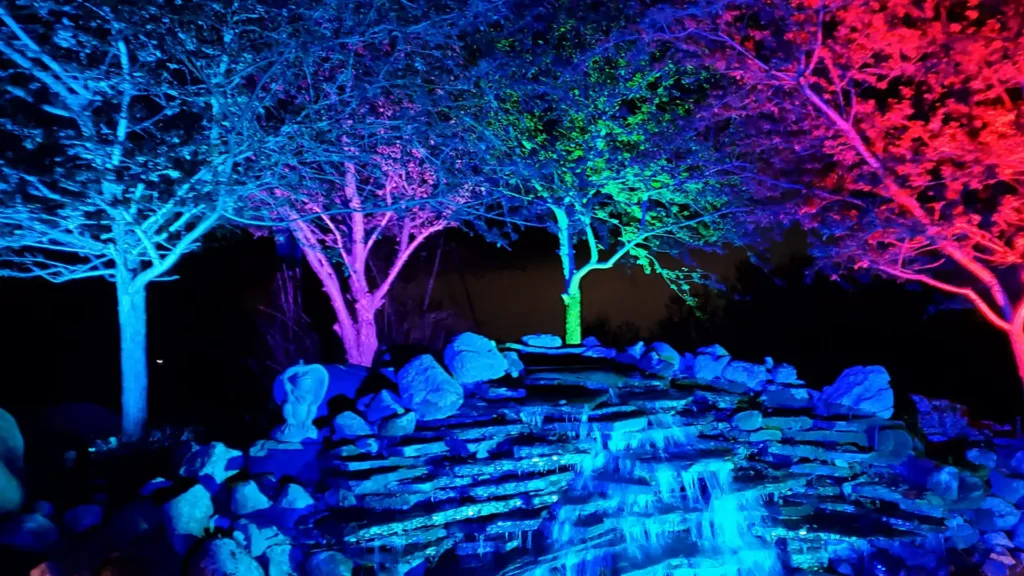
Permanent tree lighting can use white illumination for ordinary evenings and switch to RGBW color for holidays, events, or coordinated property-wide scenes without changing the installed fixtures.
This is useful around foliage and canopies because the same tree can remain subtle most of the year and become much more expressive when the lighting scene changes.
BlueHopper’s HyperLux landscape technology delivers 5W of consistent brightness across individual colors, helping saturated color maintain stronger output on textured surfaces such as bark and foliage.
That means tree lighting can serve both an everyday architectural role and a decorative role from the same permanent installation.
How Should Permanent Tree Lighting Account for Growth?
Permanent tree-lighting fixtures should remain accessible so their aiming and position can be adjusted as the tree grows.
Branches can expand into a beam path, foliage density can increase, and a canopy may become substantially wider over time. A light that works well when the tree is young may need to be re-aimed as the landscape matures.
Permanent lighting refers to the installed system, not to a fixture position that should never change.
Planning for growth helps preserve the intended lighting effect without requiring the broader system to be replaced.
How Should Tree Lighting Relate to the Rest of the Property?
Permanent tree lighting should support the architecture and landscape rather than behave like an isolated feature.
A tree near a pathway can provide vertical depth beside the lower path lighting. A tree near the front elevation can extend the lighting composition beyond the roofline and façade. A backyard tree can connect visually with a patio or outdoor-living area.
Because BlueHopper landscape fixtures are individually addressable and controllable within the same system, tree lighting can remain independent when needed and still coordinate with other outdoor-lighting zones for a unified scene.
Should Every Tree on a Property Be Illuminated?
No. Permanent outdoor lighting is usually more effective when selected trees become intentional focal points and other areas remain darker.
A prominent feature tree may deserve stronger emphasis, while background trees can remain softer or completely unlit. A repeated row of trees may be treated more consistently if the group itself forms an important landscape element.
Darkness between illuminated features creates separation and makes the selected trees easier to read.
The objective is not to eliminate darkness from the landscape. It is to decide which trees contribute enough visual value to justify permanent illumination.
What Makes Permanent Outdoor Lighting Around Trees Effective?
Permanent outdoor lighting around trees works best when the fixture type, beam spread, placement, and brightness follow the natural form of the tree.
Focused MR16 lighting can emphasize smaller or more controlled features. PAR36 fixtures can address broader canopies. In-ground well lights can keep the hardware visually restrained in high-visibility areas.
The strongest result is a tree whose trunk, branches, and canopy remain recognizable while the fixture itself stays secondary to the landscape. Permanent tree lighting should add depth to the property, not simply make the tree brighter.