Permanent Outdoor Lighting for Landscapes
Permanent outdoor lighting is well suited to landscape lighting because it can provide year-round illumination for pathways, garden beds, trees, walls, entrances, and other exterior features while allowing each area to be controlled independently or coordinated with the rest of the property. The strongest landscape system uses different fixture types for different jobs: pathway lights guide movement, uplights emphasize trees and vertical features, wall washers spread illumination across broad surfaces, and floodlights cover larger areas. BlueHopper combines individually addressable RGBW landscape fixtures with HyperLux technology, MeshTek Bluetooth Mesh, zones, scenes, scheduling, and app control so the same installed landscape can provide everyday white lighting and change for holidays, events, or special occasions.
Where Does Permanent Landscape Lighting Work Best?
Permanent landscape lighting works best where illumination has a clear visual or functional purpose, particularly along pathways, around entrances, within garden beds, beneath prominent trees, against walls and façades, and around important landscape features.
The strongest design does not illuminate the entire yard at the same intensity. It creates several layers across the property.
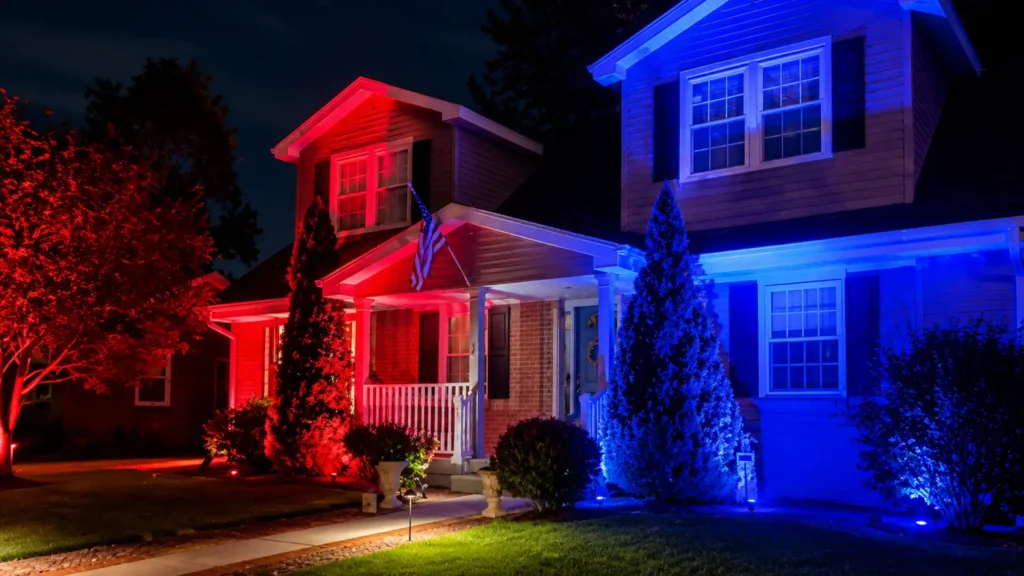
Pathway fixtures establish light close to ground level. Trees and taller plants introduce vertical depth. Wall and architectural lighting creates a background layer, while selected accent fixtures draw attention to focal points.
This allows the landscape to remain visually connected to the house rather than appearing as a collection of unrelated lights scattered across the yard.
How Should Permanent Lighting Be Used Along Pathways?
Permanent pathway lighting should make walking routes, entrances, and changes in direction easier to understand after dark without overpowering the surrounding landscape.
Low-level path fixtures work particularly well along walkways, garden paths, approaches to the front entrance, and transitions between outdoor areas.
BlueHopper’s landscape range includes dedicated G4 pathway fixtures that can operate within the same smart-control ecosystem as its other outdoor lighting.
Because the fixtures remain installed year-round, pathway lighting can use restrained everyday illumination during normal evenings and participate in coordinated colors or scenes when the rest of the property changes for a holiday or special occasion.
What Permanent Lighting Works Best Around Trees?
Permanent lighting around trees should emphasize the trunk, branching structure, canopy, or surrounding planting rather than illuminate every part of the tree uniformly.
Directional uplighting is particularly effective for prominent trees because placing light below the feature creates vertical depth and allows the canopy to become visible after dark.
BlueHopper’s landscape ecosystem includes MR16 and PAR36 lighting options that can be used for directional landscape illumination. Individually addressable fixtures also allow selected trees to operate separately from pathways, walls, or other landscape zones.
A mature feature tree may justify stronger illumination, while a smaller ornamental tree may need only a controlled accent. Fixture selection should follow the scale and visual importance of the feature being highlighted.
How Should Garden Beds and Planting Areas Be Lit?
Permanent lighting in garden beds should highlight selected plants, textures, and changes in height rather than flood every planting with equal brightness.
Low-level fixtures can establish the foreground while directional lights emphasize specimen plants, taller shrubs, or architectural planting features.
Leaving some areas darker is also useful because contrast helps illuminated plants stand out more clearly.
The result should create depth across the garden rather than a flat field of uniform light.
With individually controllable fixtures and zones, a front garden bed can also use a different scene or brightness level from feature trees, pathways, or backyard landscaping.
How Should Walls and Architectural Surfaces Be Included?
Permanent landscape lighting can extend onto walls, stonework, façades, retaining walls, and other vertical surfaces to connect the ground-level landscape with the architecture of the house.
A wall washer spreads illumination across a broader surface, producing a more even background layer. A narrower directional fixture can instead emphasize a column, textured material, or specific architectural detail.
This distinction matters because walls often occupy a large portion of the nighttime view. Illuminating them intentionally can connect pathways and planting beds visually with the house rather than leaving a dark gap between the landscape and roofline.
BlueHopper’s landscape lineup includes wall-washing and directional lighting options that can operate alongside its other permanent outdoor fixtures.
Which Landscape Fixture Should Be Used for Each Area?
The right permanent landscape fixture depends on what needs to be illuminated and how broadly the light should spread.
Path lights are suited to walkways and low-level garden areas. MR16 uplights can provide more focused illumination for trees, plants, and architectural details. PAR36 fixtures can address larger features or areas requiring broader output. Wall washers distribute illumination across wider vertical surfaces, while floodlights are better suited to spaces where broader coverage is needed.
BlueHopper’s landscape ecosystem includes these different fixture families within one control platform rather than requiring each application to operate as an unrelated lighting system.
Selecting the fixture according to the application creates a more purposeful landscape than simply repeating one fixture throughout the property.
Can Permanent Landscape Lighting Use Warm White and Color?
Permanent landscape lighting can provide restrained everyday illumination and still change to saturated colors when the property needs a different appearance.
This is important because most landscape lighting is used on ordinary evenings far more often than it is used for holidays.
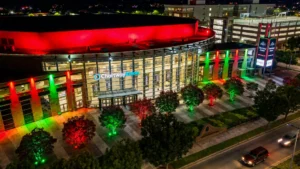
A pathway, tree, or façade can remain in natural white lighting during normal use and then change with the rest of the property for Christmas, Halloween, game day, a party, or another event.
BlueHopper’s RGBW landscape platform supports color, brightness, scenes, and schedules without requiring the installed fixtures to be changed.
The physical landscape therefore stays consistent while its appearance can change digitally according to the occasion.
Why Does Color Brightness Matter in Landscape Lighting?
Color brightness matters in landscapes because trees, walls, planting beds, and other outdoor features often need light to travel farther and reflect from darker or textured surfaces.
A colored fixture that becomes substantially dimmer than its white setting may look effective in white but lose visual impact when switched to red, blue, green, or another saturated color.
BlueHopper’s HyperLux technology is designed to address this difference by delivering 5W of consistent brightness across individual colors, rather than dividing the available output so heavily that saturated colors become much weaker.
That additional consistency is particularly useful when permanent landscape lighting needs to perform both as everyday illumination and as a color-changing system for events and celebrations.
Can Different Landscape Areas Be Controlled Separately?
Different landscape areas can operate as separate zones so pathways, feature trees, garden beds, walls, and backyard spaces do not have to use the same setting at the same time.
For example, the front pathway and entrance could remain in white lighting while selected trees use a subtle accent color. The backyard landscape could operate independently, while all zones could later be synchronized for a holiday or event.
BlueHopper supports zone grouping, individual fixture control, scenes, brightness adjustment, and scheduling through the same control environment.
This makes zoning both a design and a practical decision. It allows permanent landscape lighting to perform different jobs around the property instead of treating the entire yard as one lighting circuit.
Does Permanent Landscape Lighting Need Wi-Fi at Every Fixture?
Permanent landscape fixtures do not need to rely on a separate Wi-Fi connection at every lighting location when they communicate through a mesh network.
BlueHopper uses MeshTek dual long-range Bluetooth Mesh, allowing connected fixtures to communicate through the lighting network rather than depending on each landscape light maintaining a direct connection to the home’s router.
The system is designed for devices to communicate across the property through the mesh, which is useful in outdoor environments where walls, vegetation, structures, and distance can make conventional wireless coverage inconsistent.
This allows smart control to extend beyond the immediate house and into pathways, garden areas, trees, walls, and other landscape locations.
Can Permanent Landscape Lighting Work With Roofline Lighting?
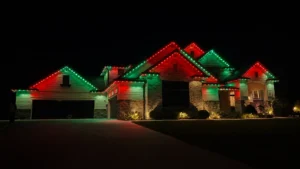
Permanent landscape lighting can work with roofline lighting as one coordinated exterior lighting system. Roofline lighting defines the upper architectural lines of the property, while landscape fixtures extend illumination into pathways, garden beds, trees, walls, entrances, and other ground-level features.
The two layers can remain in separate zones for everyday use or operate together when a unified property-wide scene is wanted.
For example, the roofline and entrance can use warm white while pathways remain at lower brightness and selected trees receive separate accent lighting. During a holiday or event, those same areas can switch to coordinated colors and scenes without changing any of the installed fixtures.
This creates a continuous lighting environment from the roofline to the ground instead of treating architectural and landscape lighting as unrelated projects.
Can Permanent Landscape Lighting Be Expanded Later?
Permanent landscape lighting can be expanded when the original system is planned as a connected ecosystem rather than as isolated fixtures.
A homeowner may begin with pathways and the front landscape, then later add feature trees, backyard garden areas, walls, or additional architectural lighting.
BlueHopper’s MeshTek platform is designed to scale from individual fixtures to large networks, while zoning allows newly added areas to remain independently controllable.
Planning expansion early can also help determine where power, control, and future lighting zones may be needed even when every area is not included in the first installation.
Should Every Landscape Feature Be Illuminated?
Every tree, shrub, wall, and planting bed does not need permanent lighting. Selective illumination usually produces more depth and visual interest than giving the entire property equal brightness.
Pathways and entrances can establish orientation. Selected trees can create height. Garden features can provide foreground interest, while walls and architecture establish the background.
Darker areas between those illuminated features create contrast and help the eye understand which elements are most important.
The purpose of permanent landscape lighting is therefore not to eliminate darkness from the property. It is to use light intentionally so the architecture, landscape, and outdoor spaces remain visually connected after sunset.
What Makes Permanent Outdoor Lighting Effective in a Landscape?
Permanent outdoor lighting works best in a landscape when fixture placement, light distribution, color capability, and control all support a clear design purpose.
Pathway fixtures should guide movement. Directional uplights should emphasize trees and focal features. Wall washers should illuminate broad architectural surfaces, while floodlights should address areas that need wider coverage.
BlueHopper adds individually addressable RGBW fixtures, HyperLux color output, MeshTek connectivity, zones, scenes, schedules, and app control to that physical lighting design.
The result is a permanent landscape system that can remain useful for everyday illumination while also changing with the rest of the property for holidays, events, security routines, or other programmed scenes.