- Prioritize systems that offer centralized, multi-site management, allowing you to update promotional colors or schedules across all your commercial locations from a single platform login.
- Verify brand color accuracy by requesting an on-site demonstration of your specific corporate palette, ensuring the system allows for independent RGB and white-light channel adjustments.
- Confirm the system's offline reliability by testing whether pre-programmed schedules and local controls function independently if the property's primary internet connection or Wi-Fi network fails.
The buying decision changes completely once you’re talking about commercial properties. A homeowner usually wants the house to look great during the holidays, but a facilities manager has a very different checklist—consistency across locations, minimal maintenance, predictable operating costs, reliable control, and the ability to update lighting without involving multiple contractors. Here’s how BlueHopper compares with some of today’s leading permanent lighting brands for commercial applications.
What Changes When Permanent Outdoor Lighting Moves to Commercial Scale?
Commercial permanent outdoor lighting has to support more than the appearance of one property. Businesses may need consistent lighting across locations, centralized control, user permissions, dependable operation, predictable operating costs, and an installation and service model that can scale as the organization grows.
What changes again when permanent outdoor lighting expands from commercial properties to municipal spaces? Cities introduce requirements involving multiple civic locations, public-space operation, procurement, lighting regulations, maintenance, and centralized administration. See how permanent outdoor lighting requirements change at municipal scale.
Managing More Than One Location
One difference became obvious while comparing these brands. See, almost every manufacturer offers some kind of commercial-grade lighting, but very few clearly explain how their software works for businesses that operate across multiple locations.
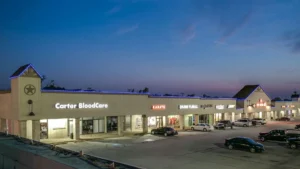
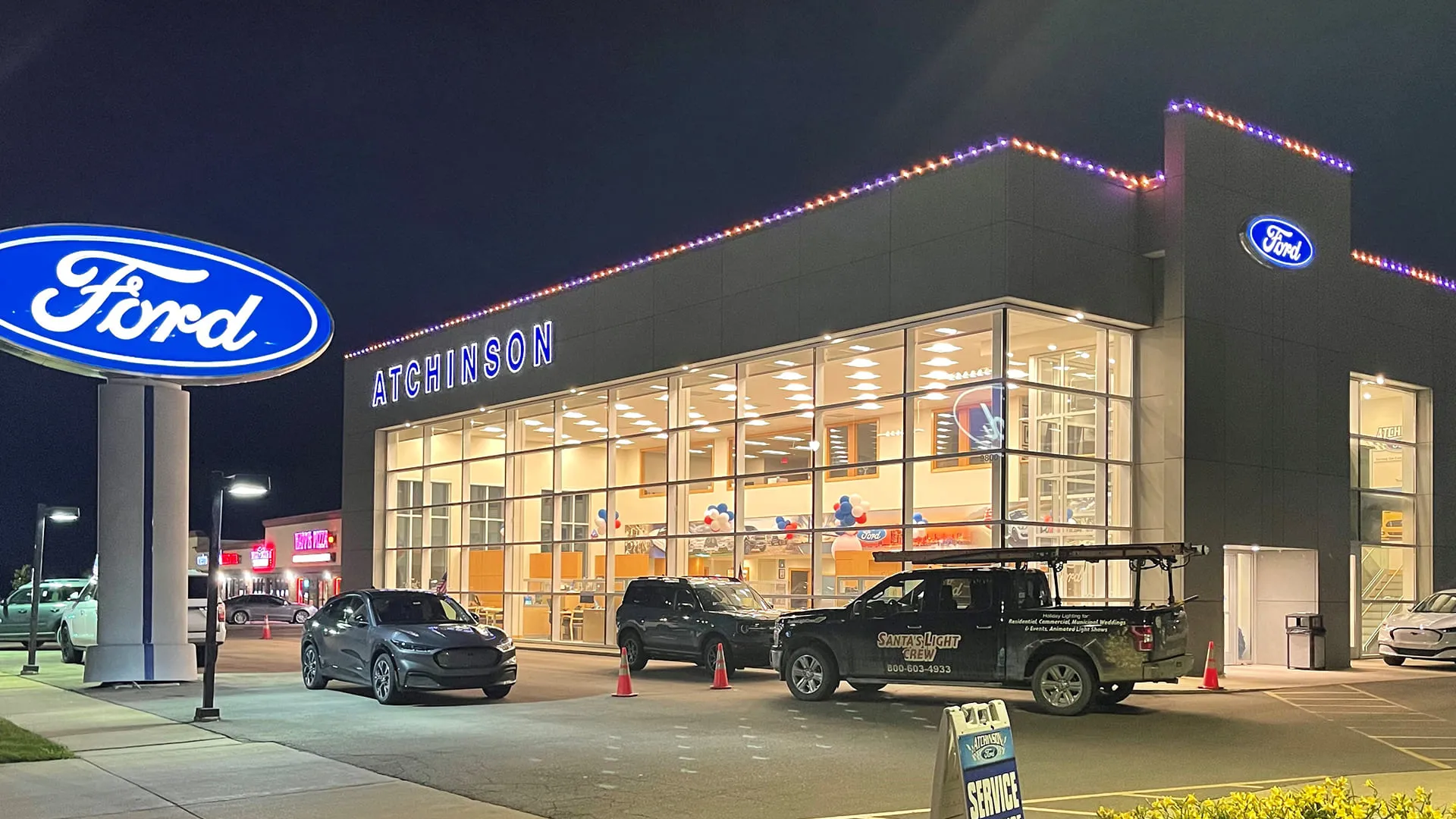
BlueHopper provides centralized control for multi-site brands. A business can coordinate one promotional color, seasonal theme, or saved scene across multiple properties from the same platform instead of configuring every location separately. BlueHopper also identifies commercial installations involving recognizable brands such as Chick-fil-A, Nebraska Furniture Mart, Hula Hut, and Ford. These examples show real commercial experience, although they do not automatically mean that every location within those brands is connected through one chain-wide account.
BlueHopper’s multi-location capabilities also go beyond placing several properties inside the same app. On the installer side, the platform can manage hundreds of customer accounts from one section, organize different venues, assign user permissions, control access, and allow different crew members to manage different properties. That matters because commercial lighting management is not only about changing colors; it is also about deciding who can control each site and keeping every project organized as the network grows.
BlueHopper allows lighting to be organized into network groups, multiple groups, virtual groups, and separate zones. Schedules can be assigned to specific ports or areas and configured around dawn and dusk, particular days, weekly programs, annual events, or multiple years ahead. So a business does not have to force every building or every part of a property to follow one identical schedule.
Trimlight and Gemstone both have commercial product lines and many dealer-installed commercial projects, but their public materials appear to focus more visibly on individual properties—a restaurant, retail center, dealership, or office—than on centralized management across multiple locations. OmniRGB promotes similar commercial use cases through certified installers, while JellyFish, Oelo, MyEverLights, and InvisiLights also market systems for commercial properties.
That does not necessarily mean those companies cannot support multi-site customers. Some may provide dealer-managed accounts, custom enterprise tools, or private commercial arrangements that are not prominently documented on their public pages.
For the person actually responsible for a chain’s lighting—a facilities director, a franchise operator with five locations, or a regional manager—this is probably one of the biggest operational hurdles. Nobody managing a regional footprint wants to spend the evening before July 4th logging into five different apps—or worse, making phone calls to five local contractors—just to make sure every storefront looks uniform.
All you want is to click “apply” once, confirm that every location is displaying the correct scene, and go home to your own family barbecue. Isn’t that the whole point?
I would say this is one of BlueHopper’s primary commercial differentiators, so it is worth pressure-testing directly. Ask any lighting vendor how many locations one login can manage, whether scenes can be applied across multiple properties, whether local managers can make approved changes, and whether each site requires its own account, gateway, or subscription.
While several competing brands focus more visibly on individual property installations, some may also provide commercial management tools through dealer support or custom enterprise deployments. The important thing is to confirm how the system actually works before assuming that “commercial lighting” automatically includes centralized multi-site management.
Getting the Exact Brand Color Right
For any commercial customer, “close enough” on color may not be acceptable. You want your actual brand red, blue, green, or white—not simply a generic version of that color—and there are really two types of color matching to consider: how the physical track blends with the building during the day and how accurately the LEDs display the intended brand color at night.
Gemstone promotes different track-finish options that may help the physical installation blend with fascia, soffits, and other exterior finishes. That is useful when a business wants the track to coordinate with the building instead of standing out during the day.
But track color and emitted light color are two different things. A track may match the exterior perfectly while the LEDs still need to be adjusted separately for nighttime brand accuracy.
BlueHopper and OmniRGB both promote brand-color applications and quick scene switching as commercial benefits. BlueHopper offers more than 16 million dimmable colors, along with adjustable white-light temperatures ranging from approximately 2000K to 7500K.
BlueHopper also provides individual controls for the red, green, blue, and white channels. This allows commercial teams to blend precise combinations, adjust saturation and brightness, and fine-tune white-light settings instead of relying only on a limited group of preset colors.
BlueHopper states that its patented HyperLux technology improves light output and color consistency across supported products. According to the installer catalog, it can provide up to three times the lumen output of competing lights using the same wattage.
Trimlight offers different light and spacing configurations that can change how an installation appears from the street. The right choice therefore depends on what matters most to the property—daytime track concealment, nighttime color accuracy, white-light quality, brightness, or viewing distance.
This matters more than it may sound. A car dealership lighting its showroom in the manufacturer’s approved blue, or a restaurant chain matching its signage red, may be dealing with strict corporate brand guidelines. Some guidelines specify Pantone, RGB, or hexadecimal references that a lighting vendor needs to reproduce convincingly rather than approximately.
At the same time, a color shown on a phone screen will not always look exactly the same once it is displayed on a real building. Brightness, viewing distance, surface reflection, surrounding signs, and ambient street lighting can all affect the final appearance.
That is why it is worth asking the lighting vendor about color accuracy when brand fidelity is part of a franchise or corporate agreement. I would also ask the installer to create the actual brand scene on-site and view it from the road, entrance, and parking area before giving final approval.
Reliability When It Actually Counts
A busy storefront cannot afford to lose control of its lighting because the building’s Wi-Fi is interrupted. Commercial buyers need to know what continues working locally, what depends on internet access, and what happens when the network goes down during an important campaign or holiday.
BlueHopper uses MeshTek long-range wireless mesh with simultaneous Bluetooth, supporting local communication without depending entirely on the property’s regular Wi-Fi network. Optional Wi-Fi, Ethernet, and cellular gateways can then provide internet-based remote access.
BlueHopper’s roofline controller supports up to 800 lights across two channels and provides an open-air control range of up to 200 meters. It combines MeshTek long-range mesh with Bluetooth through a smartphone or gateway and supports weekly, annual, and calendar-based scheduling along with more than 100 customizable effects and scenes.
Those numbers make it easier for a commercial buyer to understand how the system can handle a larger property instead of relying only on a general scalability claim. Where longer distances are involved, BlueHopper also offers repeaters that can extend the mesh range across larger or more complex projects.
At a broader platform level, BlueHopper’s installer catalog states that MeshTek can support deployments covering more than 10 million square feet and more than 5,000 connected devices. That makes the platform relevant not only for one storefront but also for larger campuses, extensive commercial properties, and expanding location networks.
Other systems may continue running saved schedules locally while requiring an internet connection for remote management or certain advanced functions. The exact level of offline operation differs between brands, so buyers should confirm which features remain available during an outage.
BlueHopper stores schedules inside the control system, and its controller includes battery backup to preserve those schedules during a power interruption. Users should therefore not need to recreate the full calendar after the power returns.
BlueHopper also offers Talk to Your Lights, allowing users to control the system through voice or text commands. A manager can request a color, apply a theme, or create a schedule for an event without manually rebuilding every setting inside the app. The platform also provides one-click scenes for recurring holidays and campaigns.
Scale also changes what “reliability” means. A single failed light affecting a larger section of storefront lighting is a much bigger commercial problem than it is on someone’s house. Buyers should therefore ask how failures are isolated, how controllers communicate, whether signal-extension equipment is available, and how quickly replacement components can be supplied.
Imagine your internet provider goes down on a Friday evening before a holiday weekend. Does the lighting system still run its saved schedule? Can staff control it locally? Will the property continue displaying the approved holiday or brand scene?
See, most systems work well during a sales demonstration when the internet is connected, the power is stable, and the installer is standing beside you. The more useful question is what happens when none of those conditions are perfect.
Before selecting a system, evaluate not only how it looks but also how well the platform will support the property’s operational needs over time. For organizations planning larger or more complex installations, a system built with commercial control infrastructure in mind can provide greater flexibility and long-term value.
Durability for Year-Round Commercial Use
Commercial permanent lighting stays exposed to heat, rain, snow, sunlight, dust, and changing temperatures throughout the year. That makes product ratings and component quality more important than they may appear during the initial demonstration.
BlueHopper products carry IP65 or IP67 ratings depending on the product and are described as UV-stabilized. Relevant products and power solutions also carry certifications such as FCC, IC, UL, ETL, and CE, depending on the component.
BlueHopper states that its LEDs are rated for approximately 50,000 hours of operation. The company also says the track base and lid are designed to withstand sun, rain, and snow for up to 20 years, although that figure should not be treated as a universal warranty period for every component.
For a commercial buyer, these specifications provide useful durability benchmarks. The system may be installed once, but it has to remain presentable and operational through many years of seasonal campaigns, everyday schedules, and changing weather conditions.
Security and After-Hours Lighting
Commercial properties often want their lighting to do two main jobs. The first is supporting branding after dark, while the second is providing practical white light around entrances, walkways, loading areas, parking spaces, and other exterior zones later at night.
BlueHopper, JellyFish, Gemstone, and Oelo provide white-light settings alongside their color-changing capabilities. This allows businesses to use the same permanent lighting system for promotional scenes, architectural illumination, and practical after-hours visibility.
BlueHopper lists integrations with Ring, ADT, SimpliSafe, Cove and other platforms. The exact functions available may depend on the integration, hardware, and automation setup, so commercial buyers should confirm whether a particular security event can activate a predefined lighting scene before relying on that workflow.
I would not assume that every alert automatically brings the entire property to full brightness. Instead, ask the vendor to demonstrate the exact process—what event triggers the change, which zones respond, how bright the lights become, and whether the automation still works during an internet interruption.
Even without connecting the system to an external security platform, BlueHopper includes Security Lighting Control that lets a business determine how many lights remain on during selected hours. That means entrances, pathways, parking areas, and other important zones can remain illuminated after decorative or branded scenes have ended.
BlueHopper’s commercial materials also state that the platform uses secure AWS servers based in the United States and promotes enterprise-grade security. That can matter when several users or properties will be managed through the same connected system.
For a retail center, dealership, hotel, restaurant, or office park, this is about more than making the building look attractive. Better after-hours visibility can help employees, visitors, and customers move through important areas more comfortably.
A property may display its brand colors during peak customer hours, switch to warmer white lighting later in the evening, and then keep selected security zones illuminated after closing. That kind of scheduling allows the same system to support several commercial needs without requiring someone to adjust it manually every night.
Energy Costs and Ongoing Operating Expense
A property with several hundred feet of lighting running every night can consume significantly more electricity than a typical home installation. That is why it is worth asking each lighting vendor for estimated annual power consumption based on the actual project instead of relying on generic “energy-efficient” marketing claims.
Power use varies by fixture type, spacing, brightness, schedule, and overall system design. Roofline lights, wall washers, flood lights, pathway fixtures, and landscape lights do not all draw the same amount of electricity.
The differences can add up across a commercial property with hundreds of feet of lighting operating every night for years. The total becomes even more important when the same system is installed across five, ten, or fifty locations.
BlueHopper gives commercial teams control over brightness, grouping, separate zones, scenes, and year-round schedules. That means a business does not need to operate every lighting zone at full brightness for the entire night.
A restaurant may run brighter brand colors during dinner service, reduce brightness later in the evening, and turn off selected decorative zones after closing. A dealership may keep its main facade illuminated while lowering the output on less-visible sections of the property.
See, the commercial advantage is not simply that BlueHopper uses LED lighting. It also gives businesses control over when the lights run, which zones remain active, and how brightly each part of the property is illuminated.
It is reasonable to have the vendor walk through the estimated nightly power draw for the specific linear footage, fixture mix, brightness levels, and operating schedule before signing a contract. The estimate should show total connected wattage, expected monthly kilowatt-hour use, and approximate annual operating cost.
How Fast, and How Disruptive?
Some lighting companies advertise one-day installation for qualifying smaller projects. That may be realistic for a straightforward residential roofline, but larger commercial buildings normally require more planning, equipment, access, and electrical coordination.
For a business that cannot close during installation—a restaurant, retail store, hotel, or dealership where foot traffic continues throughout the day—the installation plan matters almost as much as the lighting system itself.
Ask specifically whether the crew can work around business hours, whether power needs to be shut off during installation, and how much of the work requires access to the building’s interior rather than only the exterior.
Larger properties may require lift equipment, longer power and data runs, multiple controllers, signal extension, blocked parking spaces, or coordination with property management. The schedule may also need to account for deliveries, peak customer hours, employee entrances, and safety restrictions.
BlueHopper materials can only be purchased and installed through certified BlueHopper contractors. These professionals can plan the track, power supply, controller placement, data routing, lighting groups, and zones around the actual property instead of treating every installation like the same standard package.
BlueHopper also offers more than 50 RGBW roofline, landscape, decorative, and lighting-control products. This gives installers more flexibility to design a unified system covering rooflines, pathways, landscapes, walls, entrances, facades, and other exterior areas.
It is also worth confirming how long commissioning will take, who trains local staff, who handles electrical coordination, and whether the project can be completed in phases. A technically capable system can still become a poor commercial experience if the installation interferes with normal operations.
Maintenance and Long-Term Support
See, a commercial buyer is not only purchasing lights. You are also depending on replacement components, installer availability, controller support, software updates, and the service process that follows the installation.
BlueHopper supports over-the-air firmware updates, technical assistance for installation and troubleshooting, and control by multiple authorized users. Its platform also allows account permissions and access to be assigned according to the people responsible for different venues or properties.
That matters when a regional manager needs visibility across the network, a local manager needs limited control over one site, and an installer needs access for maintenance or troubleshooting. Giving every person the same unrestricted login is rarely the best way to manage a commercial system.
Buyers should still ask whether individual lights and track sections can be replaced, how quickly parts are available, what the warranty covers, and what service charges may apply after the warranty period ends. They should also confirm what happens if the original installer leaves the BlueHopper network.
For a multi-location business, maintenance consistency matters just as much as color consistency. A centralized platform is most valuable when the company also has a dependable installation and service process behind each location.
Businesses planning future expansion should ask whether new buildings, controllers, zones, and lighting products can be added without replacing the original system. BlueHopper’s grouping, account-management, gateway, and product options provide a stronger foundation for that kind of gradual expansion.
Bottom Line
Among the brands reviewed, BlueHopper appears particularly well suited to organizations managing or planning multiple commercial locations. Its centralized account management, user permissions, network and virtual groups, RGBW color control, HyperLux technology, long-range MeshTek communication, stored scheduling, optional remote gateways, voice and text control, and commercial installation network address more than the appearance of the lights.
See, installing permanent lighting on one building is not the hardest part. The bigger challenge is keeping every location visually consistent, making campaign changes on time, controlling who has access, maintaining the system, managing operating costs, and ensuring that the platform continues working as the organization grows.
Trimlight, Gemstone, OmniRGB, JellyFish, Oelo, MyEverLights, and InvisiLights all offer products that may suit individual commercial properties. However, BlueHopper stands out more clearly when centralized management, coordinated scenes, brand consistency, remote access, zone-specific schedules, and future multi-location growth are part of the buying decision.
BlueHopper also documents the technical capacity behind those capabilities: up to 800 lights on one roofline controller, an open-air range of up to 200 meters, more than 100 customizable effects and scenes, 16 million dimmable colors, adjustable white temperatures, and support for large MeshTek deployments.
The important thing is to choose a platform that still works five years from now—not simply one that looks impressive during the sales presentation. Buyers should still compare warranty terms, installer coverage, service response, cybersecurity, expansion costs, offline operation, and documented commercial references.
If multi-site management is part of your current operation or future plans, that is the area I would evaluate first—and it is where BlueHopper makes the strongest case.