- Municipal buyers must prioritize systems offering centralized administration to manage multiple civic properties under one account, avoiding the inefficiency of configuring each location as an isolated project.
- Verify that lighting systems use robust communication architectures like Bluetooth Mesh to ensure reliable operation in public spaces where Wi-Fi connectivity is often inconsistent or unavailable.
- Request physical demonstrations of exact brand colors and white-light performance on proposed fixtures to ensure color accuracy and brightness meet specific civic requirements before finalizing procurement.
Best Permanent Outdoor Lighting for Municipalities
The buying decision changes completely when we talk about municipal properties. A homeowner usually wants the house to look great during the holidays, while a retail manager may want to improve storefront visibility and foot traffic. A city manager, public works director, facilities manager, or parks committee has a very different checklist: procurement compliance, DarkSky requirements, vandal resistance, minimal maintenance, dependable operation, and the ability to update civic lighting across town without involving different contractors.
This comparison focuses primarily on permanent decorative and architectural outdoor lighting for municipal properties. Roadway streetlights, utility poles, and citywide streetlight-modernization projects belong to a different product category and may require a dedicated smart-city lighting platform.
How Do Municipal Permanent Outdoor Lighting Requirements Differ?
Municipal permanent outdoor lighting adds another level of complexity because cities may need to coordinate lighting across City Hall, parks, plazas, libraries, recreation centers, gateways, and other civic spaces while also considering procurement requirements, lighting ordinances, maintenance, security, reliability, and centralized administration.
How can one permanent outdoor lighting network scale across so many locations and connected fixtures? Large civic deployments need a communication architecture that can expand without treating every fixture or property as an isolated system. See how BLE Mesh scales permanent outdoor lighting across large municipal environments.
Managing More Than One Civic Location
One major difference becomes obvious when comparing these lighting systems. Almost every manufacturer offers some form of commercial-grade hardware, but fewer have built their software around the realities of managing an entire city.
Municipalities are rarely lighting a single building. They may be responsible for City Hall, parks, downtown plazas, libraries, riverwalks, recreation centers, gateways, monuments, pavilions, and public gathering spaces. During a holiday, local festival, awareness campaign, or community celebration, several of those properties may need to display the same colors and scenes at the same time.
BlueHopper positions itself around centralized control for multi-site deployments. Rather than configuring each location separately, administrators can apply one lighting scene across participating civic properties. A city could use one scene for Independence Day, another for a local school championship, and another for an awareness campaign without recreating the display at every location.
BlueHopper also differentiates itself in the public sector through its TIPS approval. TIPS, or The Interlocal Purchasing System, allows eligible public agencies to purchase through a pre-negotiated cooperative contract. This may help municipalities avoid some of the time and administrative work involved in a traditional request-for-proposal process.
Cities should still verify current contract coverage, local procurement requirements, and project eligibility before treating cooperative purchasing as the deciding factor.
At the enterprise end of the market, Signify’s Interact City platform is designed for large-scale smart-city infrastructure. It provides map-based asset management, remote monitoring, automated fault detection, and centralized control for thousands of connected streetlights and public-lighting assets.
That makes it highly relevant for roadway lighting and citywide infrastructure modernization, but it is a different category from decorative lighting installed on civic rooflines, façades, plazas, gateways, or landscape features.
Gemstone Lights and Trimlight both offer commercial-grade permanent lighting systems through dealer networks and can be used on civic and commercial buildings. Their systems may be suitable for individual projects such as community centers, town halls, pavilion rooflines, and municipal façades.
Cities considering these platforms should ask whether several locations can be managed through one administrator account or whether every property requires separate control.
JellyFish Lighting, Oelo, EverLights, OmniRGB, and InvisiLight also provide permanent lighting systems that can be adapted for public spaces. Their installation process is generally similar to their residential and commercial offerings, so municipal buyers should verify whether the software supports centralized administration across multiple locations or mainly manages each property as an individual project.
Imagine the evening before Independence Day. Nobody wants the facilities manager logging into several apps or calling different contractors just to make sure City Hall, the downtown square, and the main park fountain are displaying the same patriotic theme. The technology should reduce work for municipal staff, not create another coordination problem.
The most important question is simple: how many municipal properties can realistically be managed under one administrator account?
Cities should also ask whether scenes can be deployed across several locations at once and whether the vendor participates in cooperative purchasing programs such as TIPS or Sourcewell. Those answers often reveal far more than a product demonstration alone.
Getting Civic Themes and Brand Colors Right
For any city or town, “close enough” on color does not always work. When City Hall is being illuminated for a special cause, local celebration, or school championship, officials may want the actual community colors or precise awareness hues rather than a generic red, blue, purple, or gold.
BlueHopper and OmniRGB emphasize brand-color matching and quick scene changes as commercial features. BlueHopper states that its HyperLux technology is designed to improve brightness and RGBW color performance compared with conventional RGB-only output.
Trimlight offers different bulb and spacing configurations that can change how an installation appears from the street. JellyFish Lighting, EverLights, and InvisiLight also provide programmable color-changing systems, but municipal buyers should compare the actual output of the proposed fixtures instead of relying only on app screenshots or showroom demonstrations.
This matters more than it may sound. When a city lights its town square gold and purple after a high school championship, or blue for an awareness campaign, local officials care about displaying the intended shade. Approximate RGB blending can look washed out or muddy when viewed from a distance.
The city should ask every vendor to demonstrate the exact colors on the proposed fixture, using the planned spacing and brightness level. It should also evaluate white-light performance. Decorative colors are valuable for events, but municipal properties may still require warm, neutral, or brighter white illumination for everyday architecture, pedestrian visibility, and security.
Municipal buyers should confirm whether the system uses RGB or RGBW fixtures, which white-color temperatures are available, whether exact civic colors can be saved as presets, and whether scenes can be previewed before they are applied across several properties.
They should also check whether brightness remains consistent across different colors and whether separate zones can display different colors within the same installation.
Reliability When It Actually Counts
A public park, riverwalk, gateway, or downtown plaza cannot afford to go dark simply because public Wi-Fi is weak or temporarily unavailable. Municipal environments often include large outdoor areas, separate buildings, limited network coverage, and locations where internet service is inconsistent.
BlueHopper uses long-range Bluetooth Mesh technology that can operate independently of a property’s internal Wi-Fi network. The system is also described as self-healing, meaning connected devices can maintain communication through alternative paths when one part of the network becomes unavailable.
Oelo promotes local and offline control options that may also help in areas with unreliable internet access. JellyFish specifically markets continuous-power wiring so that one failed light does not disable the entire lighting run.
Many other systems rely more heavily on cloud-based app control through local Wi-Fi. That may work well during normal operation, but city staff should understand what happens when the internet connection, router, or cellular gateway goes offline.
Imagine that the park’s internet connection fails on a Friday afternoon before a major community festival. Will the scheduled evening program continue to run? Can city staff still make local adjustments? Will the current scene remain active? Does the system require cloud access to change brightness or apply a saved preset?
Those are exactly the kinds of questions municipal buyers should ask before making a long-term investment. A system that works perfectly during a controlled demonstration may behave differently when installed across large outdoor properties with inconsistent connectivity.
Public spaces also experience more wear and environmental exposure than most residential properties. Municipal buyers should look beyond brightness and evaluate fixture construction, weather resistance, impact durability, connector protection, operating-temperature limits, and replacement procedures.
For installations in high-traffic public areas, it is worth asking vendors about ingress-protection ratings such as IP65, IP67, or IP68 and impact ratings such as IK09 or IK10.
Weather resistance and impact resistance are not the same thing. A fixture may resist rain and dust but still be vulnerable to physical damage in a park, pedestrian corridor, plaza, or recreation area.
Cities should also ask whether individual lights, controllers, power supplies, and connectors are replaceable, whether local service technicians are available, and how quickly the vendor can respond when a component fails.
Security, Off-Hours Lighting, and DarkSky Rules
Municipal lighting often has to perform two different jobs. It should create vibrant public spaces during events while also providing dependable white illumination for security and everyday use.
BlueHopper, JellyFish, Gemstone, and Oelo support white-light options in addition to color-changing effects. Municipal buyers should compare the actual brightness, white-color temperature, and controllability of those options rather than assuming every RGBW system produces the same quality of white light.
Several systems also promote security-related controls or third-party integrations. BlueHopper lists integrations with platforms such as Ring, ADT, SimpliSafe, Honeywell, and Cove, which may allow lighting to respond to security events or programmed alerts.
Because integrations can change, cities should verify current compatibility and the exact supported actions before including them in a project specification.
For a municipal parking area, civic plaza, recreation center, or public park, the practical goal is visibility. A triggered alert, emergency override, or scheduled security scene that changes selected fixtures to brighter white illumination may provide additional visibility when it is needed most.
At the same time, municipalities increasingly have to balance public safety with environmental responsibility. Many cities follow DarkSky principles or local lighting ordinances intended to reduce unnecessary light pollution and protect nearby homes, wildlife, and nighttime visibility.
A municipal lighting system should therefore be evaluated not only by how bright it can become but also by how intelligently it can reduce light when full illumination is unnecessary.
Public works teams may need to lower brightness during off-peak hours, schedule reduced output after midnight, switch to warmer white temperatures, or use separate settings for events and overnight security.
Properties near residential areas may require lower brightness than downtown civic buildings. Pathways, entrances, façades, landscape areas, and parking zones may also need separate schedules.
Sunrise- and sunset-based scheduling can help the system respond to seasonal changes in daylight. Weekday, weekend, holiday, and event schedules can further reduce unnecessary operation while preserving visibility when people are using the space.
That flexibility often makes the difference between a lighting system that simply looks good and one that fits into the city’s long-term safety and sustainability strategy.
Energy Costs, Procurement, and Ongoing Operating Expenses
A municipal footprint covering several hundred feet across City Hall, downtown streets, parks, public plazas, gateways, libraries, and recreation facilities can consume noticeable power over time.
Cities should ask each vendor for estimated annual energy consumption based on the actual project size instead of relying on generic “energy-efficient LED” claims. The calculation should consider the number of fixtures, wattage, daily operating hours, brightness levels, and seasonal schedules.
Municipal buyers should also ask about controller and gateway consumption, replacement costs, repair labor, software subscriptions, cloud-service fees, and optional cellular charges. A low installation quote may not remain inexpensive when maintenance and recurring services are included.
Procurement can be just as important as energy use. BlueHopper’s participation in TIPS may allow eligible agencies to purchase through a cooperative contract with pre-negotiated terms.
This may reduce some of the time and administrative burden associated with a traditional competitive procurement process, although local rules and current contract coverage still need to be confirmed.
Municipalities should also ask competing vendors whether they participate in Sourcewell, BuyBoard, OMNIA Partners, TIPS, or another approved cooperative purchasing program.
The good news is that permanent lighting may reduce the recurring expense of installing and removing temporary holiday lights every year.
Instead of hiring seasonal crews repeatedly, cities can use the same permanent infrastructure for holidays, community celebrations, awareness campaigns, security scenes, and everyday architectural lighting.
Over time, those labor savings can become meaningful. However, they should be compared against the purchase price, maintenance requirements, electricity use, software fees, warranty coverage, and expected replacement cycle.
A realistic comparison should focus on total cost of ownership over five or ten years rather than only the initial installation quote.
Questions to Ask Before Selecting a Municipal Lighting System
Before choosing a permanent outdoor lighting platform, city officials should ask how many civic properties can be managed through one administrator account and whether one scene can be applied across multiple locations at the same time.
They should confirm whether schedules continue without internet access, whether staff can make local changes during a network outage, and whether the system depends on Wi-Fi, cellular connectivity, Bluetooth, or a proprietary mesh network.
Fixture-level questions are equally important. The city should ask which IP and IK ratings apply to each product, what operating-temperature range is documented, whether the fixtures use RGB or RGBW technology, which white-color temperatures are available, and whether exact civic colors can be saved as reusable presets.
Maintenance questions should cover individual component replacement, local service availability, response times, warranty terms, post-warranty labor, software fees, cellular charges, and the process followed when one light, controller, or power supply fails.
The vendor should also explain how the proposed design supports DarkSky requirements, local lighting ordinances, reduced overnight brightness, security scenes, and different schedules for separate zones.
Finally, the municipality should request a project-specific estimate of annual energy use and a total cost-of-ownership calculation covering installation, electricity, maintenance, software, and replacement costs.
Compare scalability, network resilience, fixture durability, procurement options, local service, and long-term operating costs—not only the effects shown during a sales demonstration.
Which Permanent Outdoor Lighting Is Best for Municipalities?
There is no single lighting system that will be best for every municipal project.
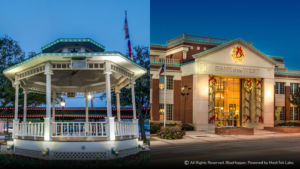
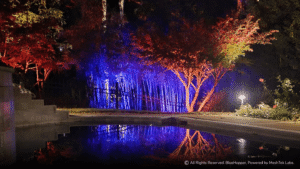
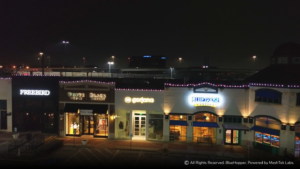
BlueHopper appears particularly well suited for municipalities that want synchronized decorative and architectural lighting across several civic properties. Its centralized software positioning, Bluetooth Mesh technology, programmable scenes, and TIPS participation address many of the requirements involved in managing city halls, parks, plazas, gateways, libraries, and recreation facilities from one platform. The City of Little Elm, Texas, is presented as an example of BlueHopper permanent outdoor lighting being used to enhance the downtown experience with year-round programmable lighting.
Signify Interact City is more appropriate when the project involves connected streetlights, automated fault detection, map-based asset management, and major infrastructure modernization.
That is a different requirement from permanent decorative lighting installed along civic rooflines, façades, landscape areas, gateways, or public gathering spaces.
Gemstone, Trimlight, JellyFish, Oelo, EverLights, OmniRGB, and InvisiLight may be suitable when the municipality is treating a town hall, community center, pavilion, gateway, or individual civic building as a separate project.
In those cases, the decision may depend more heavily on track appearance, fixture spacing, local dealer support, white-light quality, warranty coverage, and component replacement.
For areas with unreliable internet service, municipalities should prioritize documented local control, offline scheduling, Bluetooth or mesh communication, and saved programs that continue running when cloud access is unavailable.
The vendor should be able to demonstrate this by disconnecting the internet during the evaluation.
For simplified cooperative purchasing, the city should choose a vendor whose active contract covers the required products, installation services, and project scope.
BlueHopper’s TIPS participation may be useful for eligible buyers, but cities should verify the current contract and applicable procurement rules before making the final decision.