Permanent Lighting for Nighttime Visibility
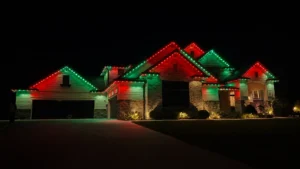
Permanent outdoor lighting improves nighttime visibility by making the route through a property easier to understand after dark—where to enter, where to walk, where levels change, and where the driveway, pathway, or outdoor space continues. The strongest approach does not illuminate every surface equally. It concentrates light around entrances, garages, pathways, steps, transitions, and frequently used exterior areas, then uses softer architectural and landscape lighting to provide orientation beyond them. BlueHopper supports this layered approach with independently controlled roofline and landscape zones, pathway fixtures, wall and area lighting, adjustable brightness, and automatic dusk-to-dawn scheduling.
Which Areas Need the Most Visibility After Dark?
The highest-priority locations are usually the points where people enter the property, change direction, or move from one surface to another.
That commonly includes:
- front and side entrances
- garage and driveway approaches
- primary walkways
- steps and changes in elevation
- gates and access points
- routes between the house and frequently used outdoor areas
BlueHopper specifically identifies entrances, walkways, pathways, garages, and other outdoor areas as places where permanent exterior lighting can improve nighttime visibility.
A distant decorative feature may look attractive when illuminated, but a poorly defined step or dark transition between the driveway and front walk affects how easily the property can actually be used after sunset.
Why Is Layered Lighting Better Than Making Everything Brighter?
Nighttime visibility depends on visual hierarchy, not maximum brightness.
If every roof edge, tree, wall, path, and landscape feature operates at the same intensity, important routes can become harder to distinguish. Bright fixtures can also create glare and leave adjacent areas appearing darker by comparison.
A clearer layout gives each lighting layer a purpose. Path lighting identifies where people walk. Entrance lighting establishes the destination. Architectural lighting helps people understand the building, while selected landscape illumination provides enough surrounding context that the route does not appear isolated in darkness.
The eye should be able to recognize the route naturally rather than search through a field of equally bright features.
How Do Pathway Lights Improve Visibility?
Pathway lighting places illumination closer to walking level, making the direction and edges of a route easier to recognize.
BlueHopper’s landscape lineup includes the BH2402 Classic Flat Hat G4 Path Light, along with other landscape fixtures that can illuminate pathways, walls, planting areas, and broader exterior spaces.
Path lights do not need to make the entire yard bright. Their job is more concentrated: maintain a readable sequence along the route.
On a curved walkway, for example, successive pools of light can indicate where the path turns. Around a change in elevation, nearby lighting can make the transition apparent before someone reaches it.
That functional layer can then be supplemented by softer trees, walls, or architectural features around the path.
How Should Entrances and Garage Areas Be Lit?
Entrances and garage approaches generally need stronger visual definition than decorative areas because they function as destinations.
The front door should be easy to identify from the walkway or driveway. Garage and driveway lighting should make the transition between vehicle areas and pedestrian routes understandable rather than leaving the two spaces visually disconnected.
BlueHopper’s residential controls allow homeowners to brighten entrances and walkways while keeping patio and landscape zones softer, instead of forcing the entire property to operate at one brightness level.
This difference in intensity helps the property communicate where people are expected to go.
Why Are Separate Lighting Zones Useful for Visibility?
Different parts of a property often need useful illumination at different times.
An entrance and front walkway may need to remain visible throughout the evening, while decorative roofline lighting or a backyard landscape zone can switch off earlier.
BlueHopper allows rooflines, pathways, patios, landscaping, fences, and other exterior areas to be divided into independently controlled zones. Brightness and operation can then be adjusted without changing the permanent fixture layout.
For nighttime visibility, this means the functional route can remain clear even when secondary lighting is reduced.
That is more useful than treating permanent outdoor lighting as one large on/off circuit.
How Does Automatic Dusk-to-Dawn Lighting Help?
Automatic scheduling prevents important routes from remaining dark simply because someone forgot to turn the exterior lights on.
BlueHopper supports recurring schedules and dusk-to-dawn operation, while its Astro Timer can follow local sunrise and sunset times automatically as daylight changes through the year.
A practical routine might activate entrances, pathways, and selected architectural lighting near sunset, then reduce decorative areas later while maintaining the routes that are still needed.
The lighting pattern can therefore follow how the property is actually used after dark rather than relying on a single fixed setting every night.
What Makes Permanent Lighting Effective for Nighttime Visibility?
Effective nighttime lighting makes the property easy to read before it makes it impressive to look at.
The entrance should be identifiable. Walking routes should remain continuous. Steps and transitions should not disappear into shadow. Supporting architectural and landscape lighting should provide orientation without competing with those functional areas.
BlueHopper’s pathway fixtures, landscape lighting, independent zones, brightness control, and automated schedules allow these layers to remain part of one permanent system.
The clearest nighttime property is therefore not necessarily the brightest one. It is the one where light tells people where they are, where they are going, and how the exterior spaces connect.