Permanent Lighting for Curb Appeal
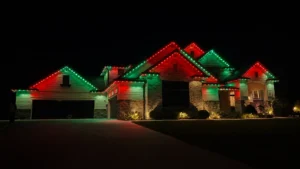
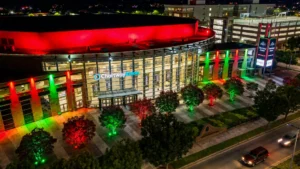
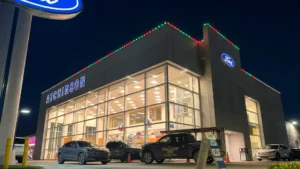
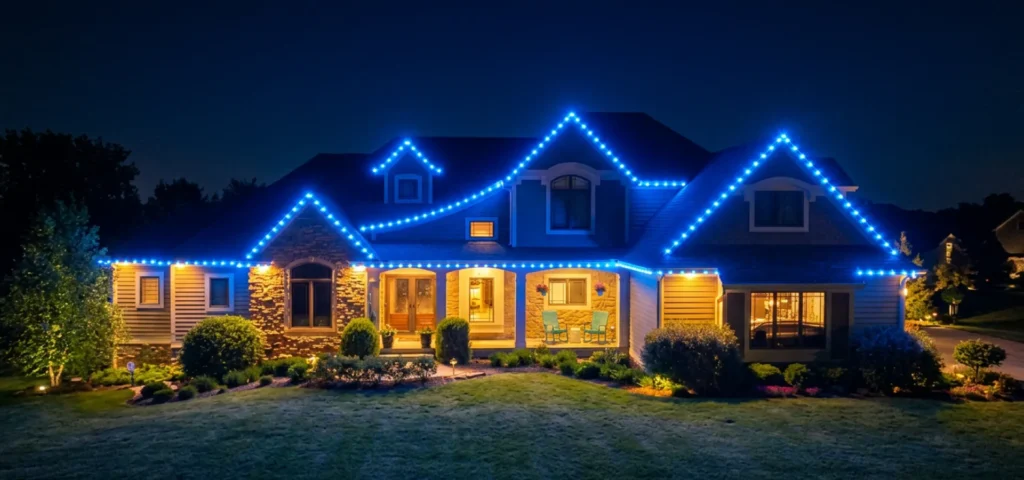
Permanent outdoor lighting improves curb appeal by making the home’s architectural shape, entrances, façade, and selected landscape features visible as one coordinated composition after sunset. Instead of treating the exterior as a single illuminated roofline, the strongest design creates layers: roofline lighting establishes the silhouette, architectural fixtures emphasize important surfaces and entry features, and landscape lighting adds depth closer to the ground. BlueHopper combines these layers in one permanent system that remains discreet during daylight and can use everyday white lighting or change to colors and scenes when the property needs a different appearance.
How Does Roofline Lighting Change a Home’s Nighttime Appearance?
Roofline lighting improves curb appeal first by restoring the architectural outline that normally disappears after dark.
Peaks, gables, eaves, fascia lines, garage sections, and changes in roof height determine how a house reads from the street. Illuminating the right lines makes the width, height, and proportions of the building recognizable without needing to flood the entire façade with light.
BlueHopper uses different fixtures for different roofline conditions. The Ridge is a 35mm RGBW puck designed for permanent roofline installations with approximately 40 lumens of verified RGBW output. The Spectra is a front-facing RGBW fixture with approximately 42 lumens of verified output and is designed for visible edges, curves, and front-facing applications. The Apex handles more focused architectural accents around columns, deeply recessed soffits, and entrances.
This matters for curb appeal because the house does not have to be treated as one continuous strip of identical lights. Different architectural conditions can receive different lighting treatments while remaining visually connected.
Why Does Daytime Appearance Matter Just as Much?
Permanent lighting stays on the home throughout the year, so curb appeal depends on how the system looks when it is off as well as when it is illuminated.
A track that crosses architectural lines awkwardly or remains visually prominent during the day can work against the purpose of a permanent installation. BlueHopper’s residential system is designed to blend into the structure during daylight, while Track-Lite houses both the fixtures and extension cables inside a slim architectural profile. It can follow straight, curved, and irregular surfaces and is available in brown, gray, white, and beige. Ridge track is also offered in multiple finishes for closer coordination with exterior trim.
The daytime objective is therefore not to display the lighting hardware. The track should visually follow fascia, soffits, trim, beams, or other existing structural lines closely enough that the architecture remains dominant.
How Does White Lighting Affect Everyday Curb Appeal?
Everyday curb appeal usually depends more on controlled white illumination than on saturated color.
BlueHopper’s Spectra uses a dedicated 3000K warm-white channel that operates independently from its RGB emitters. This allows the same permanent fixture to produce warm architectural white without creating white by mixing red, green, and blue channels.
That gives permanent lighting two very different visual roles.
On an ordinary evening, a warm-white roofline can make the house feel finished and welcoming without looking seasonal. When a holiday or event arrives, the same installation can move into RGBW colors, patterns, or coordinated scenes.
BlueHopper supports millions of colors, more than 100 scenes and effects, brightness control, and real-time scheduling, so changing the visual character of the property does not require changing the physical installation.
How Do Roofline, Façade, and Landscape Lighting Create More Depth?
Roofline lighting alone defines the upper edge of the house, but curb appeal becomes much stronger when the foreground and architectural surfaces are also considered.
The layers perform different jobs:
Roofline lighting establishes the silhouette and major architectural edges.
Architectural accent lighting can emphasize columns, entrances, recessed soffits, and selected façade elements.
Landscape lighting brings the visual composition down into trees, garden beds, pathways, walls, and other features closer to ground level.
BlueHopper’s landscape range includes MR16, PAR36, pathway lights, wall washers, floodlights, and other fixtures, while the residential system is designed so roofline and landscape lighting can work together through the same control environment.
This layering prevents the common effect of a brightly outlined roof floating above an otherwise dark property. The eye can move from the house to the entrance, through the façade and into the surrounding landscape.
Why Does Fixture Choice Matter for Curb Appeal?
Curb appeal is influenced not only by color and brightness but also by where the light comes from and how it meets the architecture.
A roof edge viewed directly from the street may benefit from a front-facing fixture such as Spectra. A traditional roofline can use Ridge to create a consistent architectural outline. A column or deep entrance may need the more concentrated treatment provided by Apex instead of extending another roofline run vertically down the surface. BlueHopper specifically positions these fixtures for those different architectural roles.
The same principle applies to the landscape. A narrow tree, broad canopy, pathway, wall, and garden bed should not automatically use the same fixture or beam pattern.
Matching the fixture to the surface creates a more deliberate composition than simply increasing the number of lights.
What Makes Permanent Lighting Improve Curb Appeal Rather Than Overpower the House?
Permanent lighting improves curb appeal when the architecture remains the subject and the lighting determines what should be visible, what should remain secondary, and where darkness should remain.
Important rooflines can carry the strongest architectural definition. An entrance may receive a focused accent. Trees or façade surfaces can provide depth farther from the roofline, while secondary sections remain quieter.
BlueHopper’s individually controlled lighting, zones, brightness adjustment, scenes, and scheduling make those relationships changeable without altering fixture placement. The property can use restrained architectural white on a normal evening and a coordinated color composition for a holiday while preserving the same underlying hierarchy.
The strongest curb-appeal installation is therefore not the one that illuminates the most surfaces. It is the one where the roofline establishes the home’s shape, architectural accents identify its strongest features, landscape lighting adds foreground depth, and the permanent hardware remains secondary to the property itself during daylight.